Overengineering Dice Rolling
We have a weekly D&D game with a few of my colleagues. We play at lunchtime. A few weeks ago, something terrible happened: our DM forgot his dice.
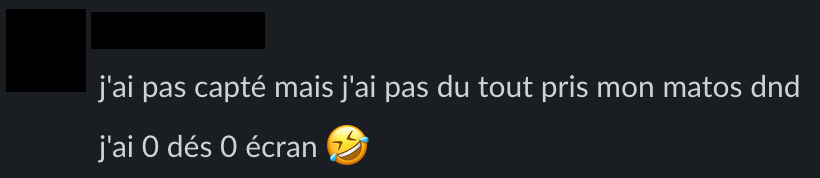 Translation from the French: “I didn’t realize, but I didn’t
bring any of my D&D stuff at all. I have 0 dice, 0 screen”
Translation from the French: “I didn’t realize, but I didn’t
bring any of my D&D stuff at all. I have 0 dice, 0 screen”
There are already thousands of websites and mobile apps for rolling
dice in role-playing games, but that would be boring. What if I made
one myself? Another tragic event happened in game: my character
died during combat. And this particular warlock believes in a higher
power, and the coming of the Great Old One in an apocalypse that will
consume the world. The warlock’s interpretation of his death is that
fate is rigged, and the dice are probably wrong.
The initial idea was very simple. Character sheets and player
handbooks use “dice expressions” like 6d4 + 4. This means “roll six
four-sided dice, add the values, and add 4”. This gives you the damage
you deal to a monster while hitting it with your amazing sword or
badass magical spell. So we could simply type a dice expression, and
the tool would simulate the dice rolls, compute the sum, and give you
the result. Quick and easy.
Dear reader: it ended up doing way more than that. Way too much.
The first version
Famously, all problems can be solved with regular expressions. So my
first version was basically this regex:
(?<sign>[+-]?)(?:(?<count>\d*)[dD](?<sides>\d+)|(?<num>\d+)), along
with some code that went through each capture group and called
random_range(1..6) if it encountered d6.
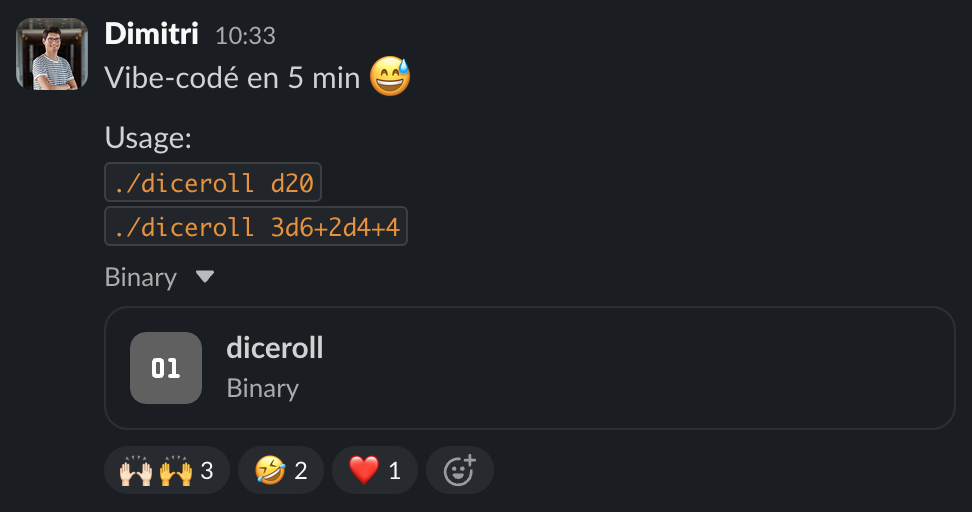
Then it’s just a matter of reading the command-line arguments, parsing them with the regex, and printing the result. I did it in Rust because I was already familiar with it, and I could quickly whip up a small command-line utility like this. And it gave me a single binary that I could share with the team.
Great.
But not enough.
The rabbit hole
Even a cursory glance at the player’s handbook will let you know that dice expressions can become much more complex than that. And my tool would not be a serious tool if it didn’t support everything, right? So I rewrote the parser to use a proper parser combinator library (nom) instead of a regex, and I happily started to implement necessary and not-so-necessary features:
- adding and subtracting dice expressions:
4d10 - 2d3 + 4, - parenthesized groups and multipliers:
d20 + (2d6+3)*2 + 5, - keep/drop highest/lowest rolls:
2d20kh1rolls ad20with advantage,4d6dl2drops the two lowest values, - re-rolls:
6d10rre-rolls 1s until the die stops showing 1, - exploding dice, minimum and maximum results, count matching, and so on. All of these modifiers can obviously be combined!
But what about the user experience? Surely our dear usersAt
this stage, “users” means “myself”.
will grow tired of the simple CLI
interface? So I added a REPL, and JSON output for programmatic use,
and a web server because why not? Someone might want to use it through
an HTTP API!
At that point it also stopped being just a dice rolling utility. I’m
quite happy with the stats command, which rolls the dice expression
many times and computes statistics, which is useful to see what you
can expect from a given combination. What is the standard deviation of
the damage dealt by your weapon? What chance do you have of hitting
that goblin with your spell?
The website
At this point I was actively looking for opportunities to overengineer this even more. What useless feature could I possibly add?
Well, I had a nice command-line tool in Rust. Being a serious person working on a serious project, I had a clean architecture, with a library and binary that called it. So where could I use that library? Rust can compile to WebAssembly, why not try that? I could call the library from a small website and roll blazing fast dice in WASM directly in the browser!
I found a cheap domain name, and shortly after, the result was accessible on diceroll.run.
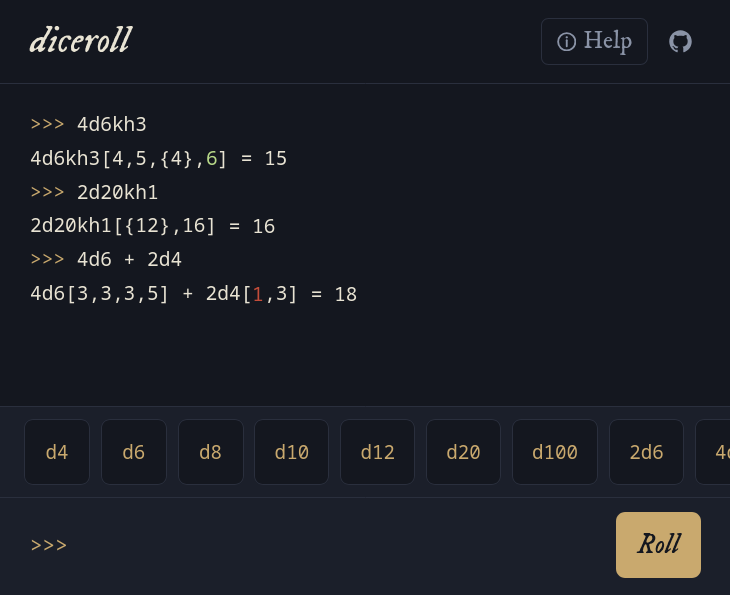
With the website, I could experiment with a lot of stuff that I wanted to explore:
- the WASM module itself of course, how to build it and use it from JS in the browser,
- generating a random seed at the start of the session for reproducibility,
- saving all the state (random seed and input history) in the URL query parameters, for easily sharing a session with other people!
Coding agents and learning opportunities
Among these vast amounts of overengineering and unnecessary features, there was at least a nice outcome: I learned a lot.
As mentioned earlier, the initial version was basically a single script generated with an AI agent. After that, as I became more invested in the features, I continued iterating with AI. But this was mostly for fun and a learning opportunity: I was under no pressure to actually deliver any of those features! So I didn’t “vibe code”, I used the agent to iterate on the code, reviewing it line-by-line as I would have done if I had written it myself.
This allowed me to iterate rapidly on the features and on the code structure. Rust was really helpful as well. I decided on the data structures and the libraries, and from there the LLM could generate very good code within the constraints of the data models and the compiler’s checks.
The parser in particular is code that can quickly become a little bit boring, even with a parser combinator library. Here the LLM could generate a battery of unit tests, and I could very easily check that it covered the most important cases, both expected successes and expected failures. Without AI assistance I don’t think I ever would have had the patience to write these tests for a side project! It’s in this sense that I believe AI agents can lead us to write much better code, especially for one-off, unimportant side projects like this.
The only part that was fully AI-generated with (almost) no supervision is the website. The HTML, CSS, and the bit of JS wrapping the WASM module was fully “vibe coded” in the sense that I didn’t read the code in detail, I just looked at the output, tried it, and iterated from there. Given that most of the logic is in the Rust library, I didn’t want to spend too much time changing CSS by hand…
With or without AI, small projects like these are a great learning opportunity. I could experiment with new (to me) libraries for parser combinators, minimal HTTP servers, CLI argument parsing, etc. The AI agent is also a great source of learning, studying the code of simple examples!
Use it (if you want)
The code is on GitHub (you can download a pre-built binary in the releases), and the website is on diceroll.run! As you can imagine, I would be very happy to hear about your ideas for new features and improvements 😛