Topology from the Kuratowski closure
The notion of open set has a classical set-theoretic definition, by its properties under unions and intersections. But there is another way to define open and closed, via an operator. This definition is equivalent to the usual one, and I find that it matches our intuition nicely, both for topological spaces and continuity.
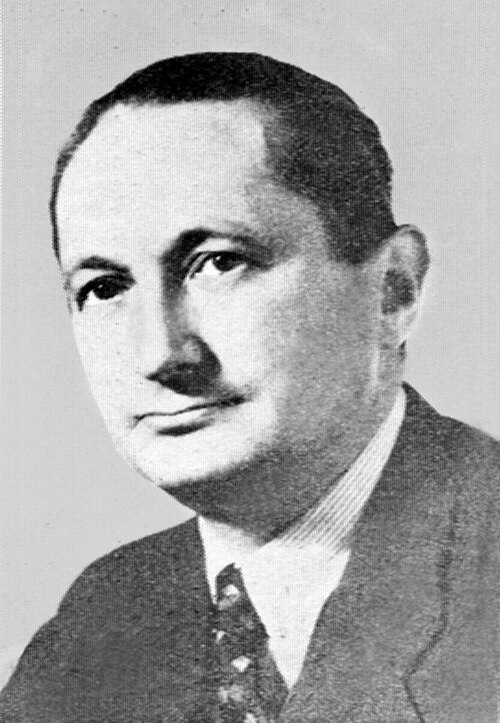
Kazimierz Kuratowski in 1959 (from Wikipedia)
This alternative definition is due to Kazimierz Kuratowski (1896–1980), a Polish mathematician who worked mainly on set theory, topology, and graph theory.
Table of Contents
The classical definition of open sets and topology
Let be a set and its power set (the set of all subsets of ).
Definition 1. A subset is a topology on , and its elements are called open sets, if the following hold:
- (i)
- The empty set and the set are open,
- (ii)
- is closed under arbitrary unions: for any collection of open sets, is open,
- (iii)
- is closed under finite intersections: for any open, is open.
The pair is called a topological space. A set is closed if its complement is open.
This definition makes sense if you already have an intuition for what an open set is, but at first it can seem a little arbitrary: why are we allowed arbitrary unions but only finite intersections? And can’t we define what an open set is instead of giving properties of the set of open sets?
Another way to define closure: the Kuratowski closure operator
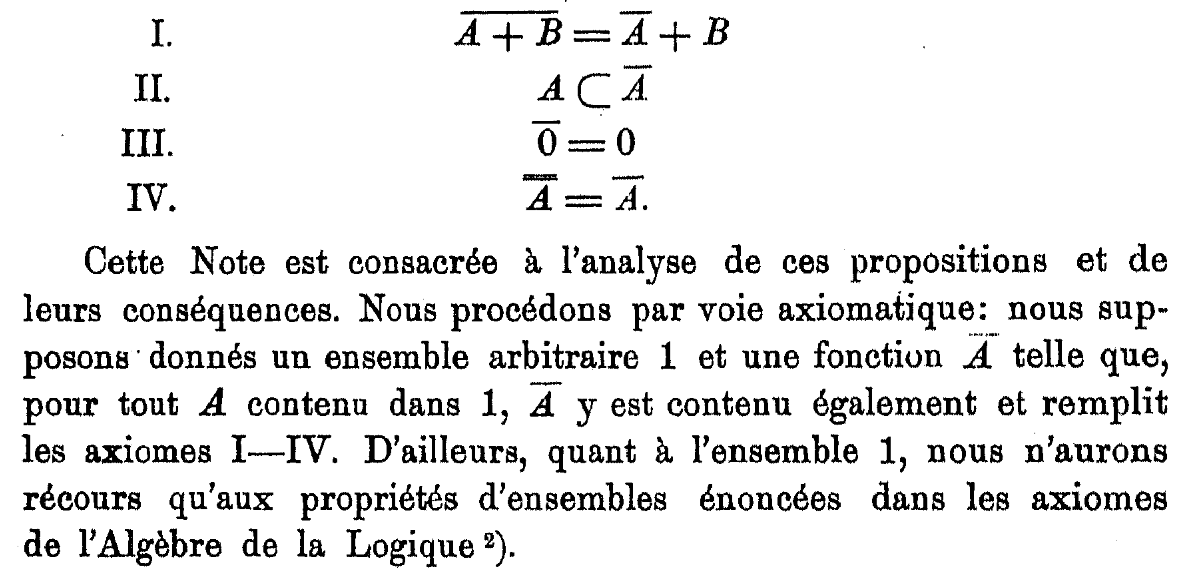
The closure axioms in Kuratowski’s original article (in French)]
Definition 2. A Kuratowski closure operator is a function such that:
- (a)
- It preserves the empty set: ,
- (b)
- It is extensive: for all , ,
- (c)
- It is idempotent: for all , ,
- (d)
- It preserves unions: for all , .
These are called the Kuratowski closure axioms.
Informally, is the set of points that are “close” to . From such an operator, we can say that a set is closed if it is left unchanged by , i.e. if , and open if its complement is closed.
An immediate property of this operator is that it is monotone with respect to inclusion in , which is consistent with the intuition behind “closeness”:
Proposition 1. A Kuratowski closure operator is monotone with respect to inclusion: for any , if , then .
Equivalence of definitions
From topology to Kuratowski closure
If we have a topology for which properties (i)-(iii) of Definition 1 hold, we can define an operator as:
From the definition, it is easy to see that for all , is closed. Indeed, by de Morgan’s laws, is a union of open sets, and therefore is open.
Proposition 2. is a Kuratowski closure operator.
Proof. Let us prove all the properties in Definition 2.
is the intersection of all closed sets that contain the empty set; since the empty set itself is closed, , proving (a).
For (b), let . is the intersection of sets that are supersets of , so .
For (c):
But itself is closed, so the intersection is itself and .
Let us now turn to (d), proving the equality by proving inclusion in both directions.
If is closed and contains , it contains and as well, so and , and
Conversely, since and , we have
Both and are closed, so by (iii) with de Morgan’s laws, is closed as well. Hence , completing the equality.
From Kuratowski closure to topology
Proposition 3. If is a Kuratowski closure operator, it induces a topology on .
Proof. For (i), we can see that by (a), and by (b), so . Therefore both and are closed and both are open.
For (ii), let be a collection of closed sets, i.e. for all , . Then
and by Proposition 1,
Hence
By (b),
so and the intersection of all is closed. Therefore an arbitrary intersection of closed sets is closed, and by de Morgan, an arbitrary union of open sets is open.
Now we turn to (iii) of Definition 1. Let be closed. By (d),
So is closed, and any finite union of closed sets is closed, which completes the proof.
Idempotence
Looking at the proof of Proposition 3, we notice that we never used property (c) of the Kuratowski closure, the one related to idempotence. This is because we don’t actually need it to prove the equivalence between the Kuratowski closure axioms and the topology axioms!
It is usually present in the list because it matches our intuition nicely about “closeness”. Without the idempotence axiom, the operator is called a preclosure operator or Čech closure operator.
So if we start from the open sets definition of a topology (Definition 1), the natural closure operator associated with it will be idempotent.
On the other hand, we can take a preclosure operator (Definition 2 without (c) idempotence) and define a valid topology (such a space where the closure operator is not assumed idempotent is called a pretopological space). Of course we can now take this topology and define a new closure operator which will be idempotent!
Continuity
Topological spaces are the natural context in which to define continuity. So it is natural to ask: how does the definition translate in terms of closure operators?
As a reminder, a function is said to be continuous if the preimage of any open set is open:
Definition 3. Let and be topological spaces. A function is continuous if for every open set in , is open in .
We can now express continuity in terms of closure operators: a continuous function maps points close to to points close to .
Proposition 4. Let and be topological spaces, with associated closure operators and .
A function is continuous if, and only if, for all ,
Proof. To simplify the notation, we will denote both and as .
Assume that is continuous.
Since , . Moreover, since is closed and is continuous, is closed. So
and by applying on both sides,
Now we show the converse implication. Recall that is continuous if and only if the preimage of every closed set is closed. Let closed. We have
Since every element of has its image by in , it belongs to , so
and by (b), , so
and is closed. Therefore is continuous.
Conclusion
What I find most interesting about this alternative formalization of a topology is that it is easy to see which axioms are essential and which are not: we have seen that idempotence is not actually needed to recover a topology from the closure axioms.
We have also seen that axiom (d) (preservation of unions) implies monotonicity (Proposition 1). If we replace axiom (d) with monotonicity itself, we end up with a closure operator, whose instances include convex hulls, linear spans, and algebraic closures. Among all closure operators, topologies are identified by the preservation of unions.